
Skill vs Degree – What Truly Matters in Today’s World of Work
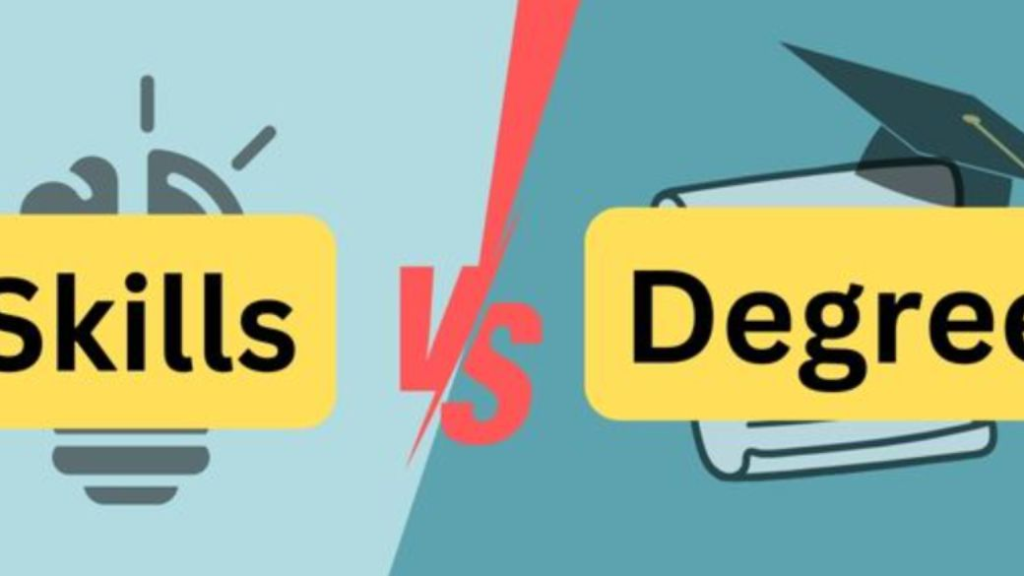
1. Introduction: A Shift That Redefined Careers
For decades, a college degree symbolized success, stability, and respect. Parents encouraged children to earn degrees, recruiters filtered candidates based on certificates, and society equated education with competence. However, the professional landscape has undergone a dramatic transformation. Today, employers ask a different question: What can you actually do?
As industries evolve rapidly, skills are emerging as the true currency of employability. While degrees still hold relevance, they no longer guarantee job readiness or long-term growth. This shift has sparked an important debate—skill vs degree: what matters today? The answer lies in understanding how work itself has changed.
In this blog, we explore this question deeply, objectively, and professionally. We analyze trends, employer expectations, real-world examples, and future opportunities to help students, professionals, and career switchers make informed decisions.
2. Degrees: Once the Golden Ticket
A degree historically served as proof of discipline, theoretical knowledge, and perseverance. Universities offered structured learning, exposure to diverse subjects, and social credibility. For many professions—medicine, law, engineering—formal degrees remain essential.
Moreover, degrees still play a role in initial screening processes. Large organizations and government institutions often require minimum educational qualifications. In traditional sectors, a degree continues to act as a baseline indicator of learning capacity.
However, the problem arises when degrees fail to evolve at the same pace as industries. Syllabi often lag behind real-world demands, and graduates enter the job market with limited practical exposure. This growing gap has reduced the standalone value of degrees in many sectors.
3. Skills: The New Professional Currency
Skills represent the ability to apply knowledge in real situations. They demonstrate competence, adaptability, and problem-solving capability. In today’s fast-moving economy, skills create immediate value for employers.
Unlike degrees, skills are measurable through output. A programmer’s code, a marketer’s campaign performance, or a designer’s portfolio speaks louder than academic transcripts. As a result, organizations increasingly prioritize hands-on expertise over formal education.
Additionally, skills can be acquired continuously. Online platforms, bootcamps, internships, and self-learning resources allow individuals to upgrade themselves without waiting years for a degree. This accessibility has democratized career growth like never before.
4. Employers Are Rewriting the Rules
Recruiters today focus on productivity, not pedigree. They seek candidates who can contribute from day one. As a result, hiring practices have shifted toward skill-based assessments, project evaluations, and practical interviews.
Many companies now remove degree requirements for roles where performance matters more than theory. They test candidates through assignments, simulations, and real-time problem-solving tasks. This approach reduces hiring risks and increases efficiency.
Furthermore, startups and tech-driven firms prefer adaptable learners over rigid degree-holders. In a volatile market, the ability to learn, unlearn, and relearn has become more valuable than static academic credentials.
5. The Rise of Skill-First Industries
Certain industries exemplify the dominance of skills over degrees. Technology, digital marketing, content creation, data analysis, UI/UX design, and freelancing thrive on demonstrable ability rather than academic background.
In these sectors, portfolios outweigh certificates. Clients and employers judge outcomes, not educational history. A skilled professional with real results often outperforms a degree-holder with limited experience.
Moreover, remote work has globalized competition. Employers now hire talent across borders, focusing on skills that deliver results. Degrees issued in one country may not carry the same value globally, but skills remain universally relevant.
6. When Degrees Still Matter
Despite the skill revolution, degrees are not obsolete. Certain professions demand regulated education, ethical training, and standardized qualifications. Healthcare, civil services, research, and academia still rely heavily on degrees.
Additionally, degrees provide foundational thinking, exposure to structured learning, and personal development. They teach patience, critical reasoning, and long-term commitment—qualities that skills alone may not cultivate fully.
The real issue is not degree versus skill, but degree without skill. When education combines theoretical knowledge with practical application, it becomes a powerful asset rather than a limitation.
7. Skill Development: A Lifelong Responsibility
Unlike degrees, skills require continuous nurturing. Technologies evolve, consumer behavior changes, and industries reinvent themselves. Professionals must actively update their skill sets to stay relevant.
Learning no longer ends with graduation. Micro-learning, certifications, workshops, and real-world projects help individuals remain competitive. Those who stop learning risk becoming obsolete, regardless of their educational background.
Importantly, skill development builds confidence. When individuals master abilities that solve real problems, they gain professional independence. This confidence often translates into leadership, innovation, and career resilience.
8. The Hybrid Advantage: Degree + Skills
The most successful professionals often combine degrees with strong skill sets. A degree provides theoretical grounding, while skills transform that knowledge into action. Together, they create a balanced professional profile.
For students, this means complementing academic studies with internships, freelancing, or practical projects. For professionals, it involves upgrading skills aligned with industry needs rather than relying solely on past qualifications.
This hybrid approach ensures adaptability. While degrees open doors, skills sustain careers. In a dynamic economy, those who blend both gain a strategic advantage over those who depend on only one.
9. Skill vs Degree for the Next Generation
Young learners face immense pressure to choose the “right” path early. However, the modern world offers flexibility. Career paths are no longer linear, and reinvention is common.
Instead of chasing degrees blindly, students should identify interests, strengths, and market demand. Skill exploration during education helps clarify career goals and reduces dependency on uncertain outcomes.
Parents and educators must also shift mindsets. Encouraging skill-building alongside formal education prepares youth for real-world challenges, not just examinations.
10. The Economic Reality: Employability Over Prestige
Economic uncertainty has amplified the importance of employability. Degrees may carry prestige, but skills pay bills. Employers prioritize individuals who can create value immediately.
Freelancers, consultants, and entrepreneurs thrive because they sell skills directly to the market. Their success depends not on certificates, but on problem-solving ability and reliability.
In contrast, degree-dependent professionals may struggle if their qualifications fail to match market demand. This reality reinforces the importance of skills as economic insurance.
11. Conclusion: What Truly Matters Today
The debate between skill and degree is not about choosing one over the other—it is about relevance. In today’s world, skills determine survival, growth, and independence, while degrees serve as supportive foundations.
A degree without skills is fragile. Skills without learning discipline may lack depth. However, skills aligned with continuous learning create unstoppable momentum.
Ultimately, the future belongs to those who can do, not just those who can show certificates. Invest in learning, practice relentlessly, and let your skills speak louder than your degrees.